Marine Court, St. Leonards-on-Sea

Marine Court, St. Leonards-on-Sea
... along the prom ...
Showing posts with label Art. Show all posts

Monday, 13 July 2015

The Hepworth, Wakefield - a Runaway Success in just 4 Years, Picture of the Week, 13.7.15

The award winning Hepworth Gallery in Wakefield opened in May 2011. As well as highlighting a collection of wonderful work by Yorkshire sculptor Barbara Hepworth, it took over the collection formerly housed in the Wakefield City Art Gallery.

The award winning building is beautifully situated on a weir on the River Calder.
Despite opening before the recession ended, visitor numbers have exceeded all expectations. The original modest hope was for up to 150,000 visitors per year, this number was achieved in the first eight weeks after opening. Even though numbers reduced slightly after the initial enthusiasm, the Hepworth greeted their one millionth visitor, a delighted Australian woman, after just two and a half years, in December 2013.

I make no apology for plugging this lovely gallery. There is no comparable place named after a woman artist that I know of and anyone who is interested in modern art or architecture shouldn't miss it. Visitors from further afield could even make an art holiday out of their visit. The Hepworth's proximity to the Yorkshire Sculpture Park has led to the formation of the Yorkshire Sculpture Triangle, helping the Hepworth's popularity. The third point in the triangle is Leeds Art Gallery and its conjoined twin the Henry Moor Institute. Four fantastic galleries and, apart from special exhibitions, entry for everyone is free!

*
 
http://www.ysculpture.co.uk/

http://ripassetseu.s3.amazonaws.com/www.hepworthwakefield.org/_files/documents/dec_13/FENT__1386266814_Press_Release_-_5_Dec_-_The_He.pdf

Wednesday, 25 December 2013

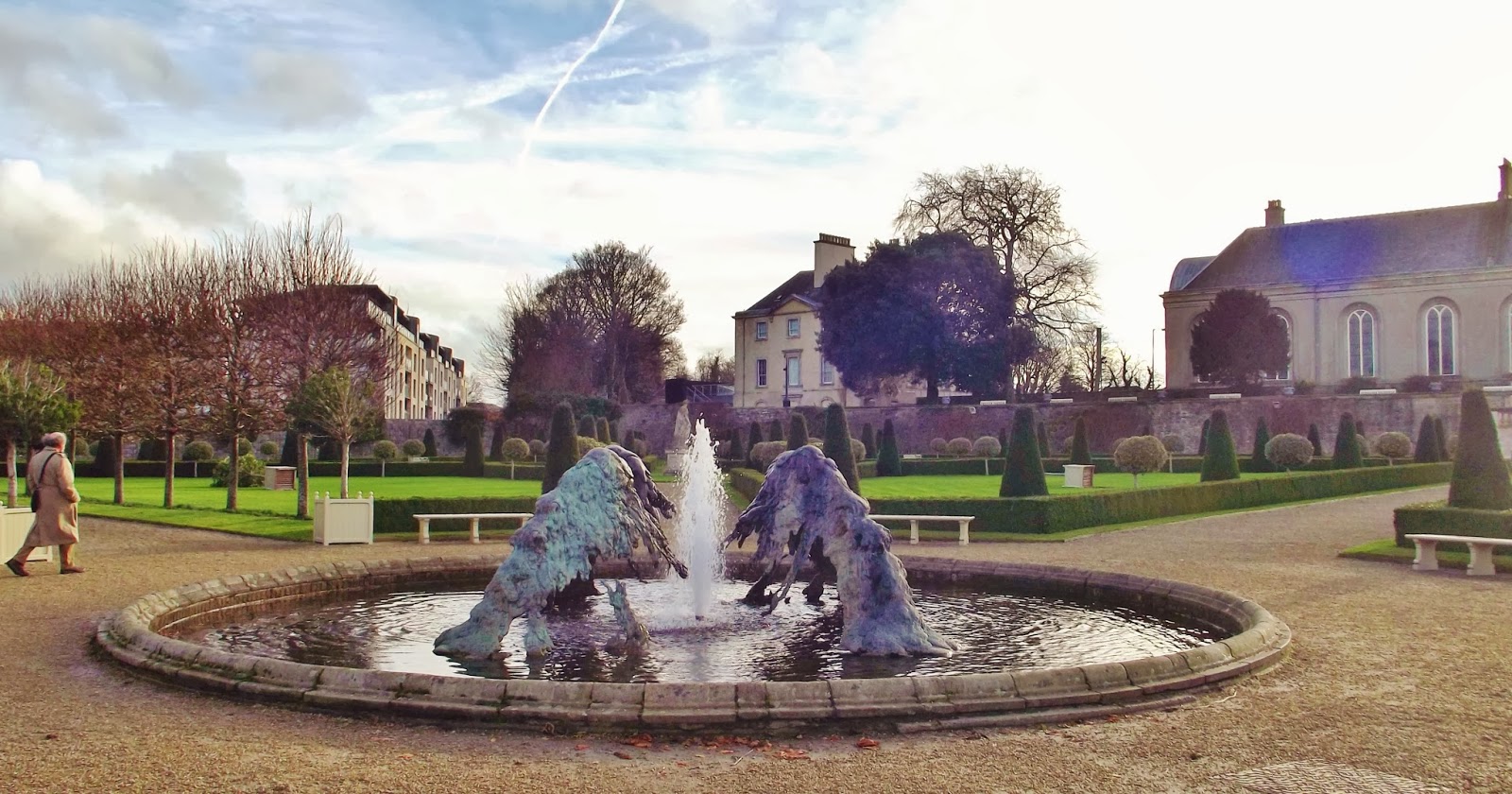
Royal Hospital Kilmainham, Picture of the Week 25 December 2013


The Irish Museum of Modern Art is housed in the Royal Hospital Kilmainham, the finest 17th-century building in Ireland. The Royal Hospital was founded in 1684 by James Butler, Duke of Ormonde and Viceroy to Charles II, as a home for retired soldiers and continued in that use for almost 250 years. The style is based on Les Invalides in Paris with a formal facade and a large elegant courtyard. The Royal Hospital in Chelsea was completed two years later and also contains many similarities in style. The Royal Hospital Kilmainham was restored by the Government in 1984 and opened as the Irish Museum of Modern Art in May 1991.

The formal gardens are being restored as part of an on-going heritage programme and already contain a number of classical and modern works of art, including the fountain sculptor by Linda Benglis.

Saturday, 12 October 2013

The Best Building in London - The Natural History Museum

This wonderful Romanesque entrance doesn't lead into a cathedral but to my favourite London building, the Natural History Museum, on Cromwell Road. The temporary barriers don't enhance the appearance, but are sometimes necessary for crowd control in a building which has almost five million visitors each year.


I was first taken to the Natural History Museum when I was just five or six and I fell in love with the building before we even got inside. The exterior of the building is covered with statues, gargoyles and plaques of creatures which were hand-modelled and then cast in terracotta. I was fascinated by the plaques around the gates which depict mice and squirrels.


Plaque depicting three mice on a gatepost
 outside the main entrance.
No creature is too insignificant, everything from mice and beetles to wolves and sabre-toothed tigers are sculpted.

Pterodactyl plaque on the roof
Large statue of a Sabre-toothed cat
on the West tower, stylised to appear
heraldic - the head was cast separately
Small plaque of a crab on a mullion between
lower ground floor windows


The designs were individually sketched by Alfred Waterhouse, the Liverpool architect who was responsible for the whole building. His sketches were then sculpted and cast by a firm of terracotta manufacturers Farmer & Brindley. The named sculptor is M. Dujardin,
his first name was possibly Oscar or Hubert. He is thought to have been French but little is now known about him.

The building's two wings depicted different groups of creatures, those ornamenting the exterior of the West wing were extinct, those on the East wing were, at the time they were modelled, still surviving. Some larger sculptures had to be cast in more than one piece and certain creatures were given heraldic stylisation.

Today the building is in a much better state than when I first saw it. The exterior was cleaned of a century's worth of London soot and grime in the 1970's, I remember it as being  all black. Now the detailed terracotta can be enjoyed in all its glory.

Saturday, 28 September 2013

Serpentine Pavilion by Sou Fujimoto; Picture of the week 28 September 2013


Every summer for the past 13 years, the Serpentine Gallery in Kensington Gardens, London, exhibits a new, temporary pavilion designed for the site by a noted architect. The new pavilion for 2013 is the creation of Japanese architect Sou Fujimoto. This is not exactly weatherproof, being a white lattice structure, consisting of 500m cubes, with a hollow centre containing a smallcafĂ©, but it's still summer in London and the fine weather has made Fujimoto's construction very popular.


The lattice encourages people to climb up, along certain designated pathways and who can resist a climbing frame? It's made of tubes, like scaffolding and is stronger than it appears. The colour gives the pavilion an almost transparent look which, combined with the overall irregular shape is intended to allow the structure to blend into the landscape and the sky. This is not quite the effect achieved but what is dramatic, apart from the obvious desire it creates in people to interact with the structure, is the constantly changing geometric patterns and altering views as you look through one cube and then another.

Sujimoto's pavilion is a great success, as a work of art it looks great and is popular. As a building, its limited functionality luckily suits the great summer weather London has had this year and overall the cloud shaped pavilion creates an exciting chance for the public to interact with the ideas of an award-winning architect.

Sunday, 15 September 2013

Street Art in St. Leonards-on-Sea - picture of the week 14 Sept 2013


Street art doesn't have to be by Banksy. Plenty if talented people can do it and St. Leonards in East Sussex is becoming quite a little artist's colony. Works include fierce faces peering down the main street, pebble sculpture and a pony in an alley.        
.
 
Some works are even officially sanctioned like the column on the prom at Warrior Square, made from sea-ravaged timbers and ornamented with padlocks and messages contributed by the public. The sculpture is called "My Heart Belongs to Hastings", which begs the question, why is it in St. Leonards?


Saturday, 10 August 2013

A visit to Yorkshire Sculpture Park (YSP) - Picture of the Week, 10 August 2013

Yinka Shonibare in landscape


'Sitting' a sculpture by Sophie Ryder, looks good beside the contrasting style of the classical orangery.
('Ten Seated Figures' by Magdelena Abakanowicz in the background)


'Buddha' by Nikki de Saint Phalle


and a wraith in the woods...
(an unnamed sculpture created on one of the many courses run by the YSP)


Saturday, 6 July 2013

Barbara Hepworth window; Picture of the Week for 6 July 2013

This sculpture stands in a window of the Hepworth, Wakefield. It overlooks the Calder wier.


Saturday, 22 June 2013

Abstraction - Old Walls; Pictures of the Week 22 June 2013


Walls are essential to all buildings. New walls are functional and we appreciate their practicality.

Old walls are beautiful, even in disrepair, especially in disrepair.


These three Old Walls are in Crete.


The shapes, colours and textures these Old Walls contain could grace any modern art gallery.


I could have manipulated the images to emphasise these abstract qualities.
It didn't seem necessary.

Thursday, 28 February 2013

The Horse is a Noble Animal - New header picture

I like to change my header picture every now and then. Meet Big Bertie. He is a horse unlikely to end up in your burger any time soon. I manage to photograph him as he trotted into the Yorkshire Sculpture Park last year, before sampling their pastures new. The horse was commissioned by sculptor Marcia Farquhar, who calls the sculpture The Horse Is A Noble Animal, after a saying of her grandmother's.

Big Bertie was the biggest hand-made rocking horse in the world. He is 3.65m (12ft) tall and 4.9m (16ft) long He was made by craftsman Tony Dew, modelled on a real horse called Bertie who is stabled near the Rocking Horse Shop at Fangfoss, a village near York. Bertie at 17 hands is not as tall as his wooden replica.

However, Big Bertie has been overshadowed by Tony Dew's later creation of Bigger Bertie, who stands 15 feet tall and weighs in at almost two tons. Both horses were largely hand made, with just the assistance of hand held tools. No lathes or industrial machinery were involved.

Bigger Bertie is still stabled at Fangfoss with original Bertie. Big Bertie still grazes at the Yorkshire Sculpture Park. Whether the three Berties will ever get together is a matter of intense press speculation...

Saturday, 19 January 2013

The City by Olga Moscow (updated) ; Picture of the Week 19 Jan 2013


The City, by Olga Moscow, oil on canvas
A splendid composition by a talented artist who sadly died on 24th February 2013 at the age of one hundred years and three months.

Originally a ballet dancer, Olga trained at the Nottingham College of Art after serving as a WAAF during the second world war. She taught art in Nottingham and Coventry. She has lived in Leeds for more than forty years. She has been an enthusiastic supporter and participant at the Swarthmore arts and education centre, where she took up creative writing after failing eyesight forced her to stop painting. Her work has been exhibited in Leeds and in Paris.

This picture was painted in the 1990's. It was used by her son Robert Evans, architect and director of ArchiFACT Ltd., for the cover of his book, Well Built? A Forensic Approach to the Prevention, Diagnosis and Cure of Building Defects, published by the Royal Institute of British Architects. The book is available through construction publications provider www.blissbooks.co.uk (and other online retailers).

Monday, 10 December 2012

Festival of Light; Pictures of the Week 12.12.12

Every year at the beginning of December, the centre of Huddersfield is brought to mysterious life in the cold evenings by the Festival of Light.


Interactive light installation in St.George's Square
An installation of burning lanterns lights up
St Peter's Gardens, by the Grade II listed Parish
Church of St Peter.


Acrobatic performance outside Huddersfield's Grade I listed
railway station. The Grade II listed George Hotel is on the right.

The festival was first held in the town only in 2006 and has become hugely popular, attracting thousands of visitors to watch and join in, with torchlight processions, live music, street theatre, food festival, daring high wire acts and fireworks to mention just a few of the highlights.


Wednesday, 25 July 2012

Masayuki Koorida - Flowers , Picture of the week 25 July 2012

For my picture of this week, I'm sticking to our last visit to the wonderful Yorkshire Sculpture Park, with this photograph of work by Japanese sculptor Masayuki Koorida. The biomorphic shapes of his pair of 2009 'Flower' sculptures sit quietly on the grass in a wooded glade like beautiful, giant, alien blooms, each one and a half metres across. They appear to have not so much grown here as just landed from elsewhere. In the background, beneath the trees, sits his 'Growth' from 2007, another alien creation.

Born in Kyoto in 1960, Masayuki Koorida has travelled and exhibited his beautifully crafted, granite sculpture internationally including in China, Germany, Italy, Nethelands, Taiwan and the USA. He currently lives in Taiwan.

Thursday, 19 July 2012

Joan Miro; Picture of the Week for 19 July 2012

Femme Monument by Joan Miro 1970 


The marvellous work of Joan Miro, Catalan surrealist extaordinaire, is on view at Yorkshire Sculpture Park for the rest of this year.


Friday, 16 March 2012

Nocturne in Blue and Gold; Picture of the Week for 16 March 2012

 Nocturne in Blue and Gold: Whistler's Pier


Between 1871 and 1875, the American artist James Abbott McNeill Whistler painted a series of pictures of the river Thames in London. The one which has become the most famous, Nocturne in Blue and Gold, depicts the silhouette of a single pier and small section of the total span of Old Battersea Bridge, against the night sky with faint lights on the distant bank and a few stars just visible. Whistler's idea came from Japanese prints which were just becoming popular amongst artists and collectors.

For its time a highly unconventional image, Whistler's dramatic romanticisation of a commonplace scene stirred up huge criticism of the artist and modern art in general. Criticism of modern art is nothing new, the unconventional is still regularly attacked by the press today. Whistler however is no longer modern and Nocturne in Blue and Gold is one of the more popular paintings in the Tate Gallery's collection, reproductions adorn many homes around the country.  

Nocturne in Blue and Gold: Whistler's Pier is my own interpretation of Whistler's idea, using today's modern medium of digital photography. It came about from a series of photographs I took of Hastings Pier at sunset on 19 Feb 2012.

Friday, 9 March 2012

The Sphinx Twice, Pictures of the Week 9th March 2012

The Great Sphinx and the Great Pyramid, Giza 1951
Photograph by Captain John Sinclair Gilbert RAMC.
Searching through my father's old photographs, which I'm slowly cataloguing and copying for posterity - well for the family anyhow - I came across this handsome black and white print ( he printed them himself) taken early in his army career.


The Sphinx in front of the Great Pyramid, Giza
Photograph by Susan Gilbert, March 2006
I already had my own versions of this image, shot from almost the identical location 55 years later! My father's is the better composition, he captured a superb cloud formation to enhance the picture, giving the ravaged giant statue a brooding air. I am still quite pleased with my shot, because of the horseman.

The poor old Sphinx - yes she is old, four and a half thousand years old is about as precise as can be ascertained - suffers severly from sand blown erosion. She has been extensively restored, to keep her  going a bit longer. She probably isn't even a she, but a representation of the Pharoh Khafre, whose Pyramid is the second largest at Giza.

She is certainly nothing to do with the legendary Sphinx, who posessed a lion's body, woman's head, the wings of an eagle and devoured those who could not answer her riddles. Giza's Sphinx never had wings and that story was anyway part of Greek mythology, not Egyptian. The word Sphinx is Greek and was only applied to her thousands of years after her creation.

She is probably one of the wonders of the world which will be lost in the not too distant future, and for once I don't believe we can blame global warming, though we are still mainly to blame. A highly knowledgeable tour guide, Magdi, who was an Egyptian historian, told us that the Sphinx was almost completely buried in sand dunes for many centuries, which protected her from the worst effects of erosion from wind blown sand, until enthusiastic Western archaeologists dug her out. During one of the wars of the past two centuries she was also used for target practice, further damaging her face.

Thursday, 16 February 2012

Dada Script, Picture of the Week for 16 February 2011

dAdA ScRiPt  One of my hats is as a playwright.


Here is Marcel Duchamp and The Dada Baroness, Elsa von Freytag-Loringhoven, rehearsing an extract from a play I wrote & directed. At the rear is the Script, trying to keep order.
Cast:
The Dada Baroness - Irene Lofthouse
Marcel Duchamp - Richard Houghton-Evans
The Script - Lee Petcher
dAdA ScRiPt was one of five short pieces forming an evening of 'Midget Gems' at the Carriageworks Theatre, Leeds, in October 2009, produced by Jan Perry and Pink Lady Productions.

Thursday, 9 February 2012

Hepworth Gallery,Picture of the Week for 9 February 2012

Vote for the Hepworth, Wakefield!


 The Hepworth gallery sits on the River Calder, opposite a boat yard.

The Hepworth is up for a prestigious award, the Art Fund Prize, which is awarded for the best museum or gallery in the UK. The public can vote for their favorite from a list of ten - go to www.artfundprize.org.uk.

Saturday, 4 February 2012

Dorothea Tanning Obituary

Dorothea Tanning 1910 – 2012,was the Last Old-School Surrealist and the Oldest Emerging Poet

Artist and poet Dorothea Tanning has died at the marvellous age of one-hundred and one. She discovered the route into her own creativity via an exhibition of Surrealist art. In 1936 she had just moved to New York, with an ambition to be a successful painter, but was forced to earn her living as a waitress and catalogue designer. She was only vaguely aware of Surrealism before she visited Fantastic Art, Dada, Surrealism, Alfred Barr’s momentous show at the new Museum of Modern Art. The work that the 26 year old painter saw there was a revelation to her, for the first time she found something matching her own visions. She had drawn and painted from a very young age and as a child created a surrealist image without any prior knowledge, when she painted a nude with leaves for hair, to the horror of her Lutheran parents. Whether they were more horrified by the leaves or the nudity is not entirely clear.

Dorothea’s parents were Swedish immigrants, living in the rural county of Galesburg, Illinois. The family called her Dottie. Despite their religious outlook, her mother encouraged theatricality in her three daughters and her father took them to see cowboy movies. Dorothea yearned after actor Lord Churlton, the villain of the Westerns, rather than the hero, Tom Mix. She said later, “I have been very perverse over a very long period and I don’t suppose I’ll be anything else”.  As a teenager her perversity also took the form of an ambition to live in Paris and be an artist. Her early career was deliberately conceived as a step by step journey towards this end, though she would not actually live and work in Paris until she was forty years old.

In 1932 Dorothea left home and to her parents dismay moved to Chicago, where she began a Bohemian existence, having very briefly attended as a student at the Art Institute of Chicago. She abandoned her studies after only three weeks. She found the regime too restrictive and spent some time exploring the Institute’s art collection. She evolved a flawless technique as a painter with little tuition and she certainly felt no need to be taught what to paint. Her skilfully executed works have always personified her own ideas, proving how correct she was to have faith in her own talent and reject formal tutoring. To earn her keep, she began work as a commercial artist.


Friday, 23 December 2011

Barbara Hepworth Stolen, Picture of the Week for 23 December 2011

Stolen - Barbara Hepworth Masterpiece worth £500,000


Window, Hepworth Gallery, Wakefield

The sculptural figure in this window by Barbara Hepworth, is pictured with some of its admirers. It is safe inside the walls and glass of the gallery, dedicated to the sculptor, which was opened in May this year.

Another sculpture of hers, which has been admired out in the open in Dulwich Park, London since 1970, has been stolen, presumably by metal thieves. It is a large abstract bronze, "Two Forces (Divided Circle)" created by Barbara Hepworth in the 1960's. The sculpture was cut from its plinth some time in the early hours of Monday 19th December.

The greedy idiots who did this have no concept of the true value of this irreplaceable work of art. They may flog it for a couple of hundred quid. The insurance policy may pay as much as half a million, but everybody except the thieves would rather have the sculpture back. The Hepworth Estate are said to have offered a reward of £5,000 for information.

This is the latest in a series of thefts of sculptures, plaques and other metal objects owned by us, the British public, which have been stolen from us. Not to mention the power lines, electric train and signalling cables which vanish every week! This is our property that these ****s are stealing.

It has to be time to legislate against anyone buying or selling scrap metal who is unauthorised and/or where the source of the scrap cannot be traced and proved legitimate. Write to your MP! I shall be writing to mine.