For thousands of years, women have been subjugated by the systems established by and for the benefit of men. Over the past hundred years, some of these systems have been challenged and changed to the benefit of us women in Western society. But for a number of years now, this rate of change has levelled out. Although we can see there is still much that needs changing, we are living on a privileged plateau compared to most of the women in the world. And the warning to us is, pay attention, because even though we can still see the unfairness and systemic prejudice against women in the existing set up, “This may well be as good as it gets.”
Marine Court, St. Leonards-on-Sea

... along the prom ...
Showing posts with label reviews. Show all posts
Showing posts with label reviews. Show all posts
Sunday, 18 March 2012
Together, We can be Strangely Better
'Top Girls’ by Caryl
Churchill and the ‘Vamps, Vixens and Feminists Conference’ gave top billing to
feminism at West Yorkshire Playhouse, Leeds early in March. The Playhouse’s Courtyard Theatre hosted these two
significant events which highlighted the position of women in society and in theatre.
The most widely publicised and best attended
was the touring production of ‘Top Girls’. This is Caryl Churchill’s great play on the
cost, to 1980’s women, of the ‘I want it all and I want it now’ culture. However, Top Girls ran for twelve days before
moving on to Exeter Northcott Theatre, it took something else to single out the
second March as a special day.
For thousands of years, women have been subjugated by the systems established by and for the benefit of men. Over the past hundred years, some of these systems have been challenged and changed to the benefit of us women in Western society. But for a number of years now, this rate of change has levelled out. Although we can see there is still much that needs changing, we are living on a privileged plateau compared to most of the women in the world. And the warning to us is, pay attention, because even though we can still see the unfairness and systemic prejudice against women in the existing set up, “This may well be as good as it gets.”
For thousands of years, women have been subjugated by the systems established by and for the benefit of men. Over the past hundred years, some of these systems have been challenged and changed to the benefit of us women in Western society. But for a number of years now, this rate of change has levelled out. Although we can see there is still much that needs changing, we are living on a privileged plateau compared to most of the women in the world. And the warning to us is, pay attention, because even though we can still see the unfairness and systemic prejudice against women in the existing set up, “This may well be as good as it gets.”


Saturday, 15 October 2011
Pylons - Reaching for the Clouds - Update
The results of the RIBA/National Grid pylon competition were announced on 12th October 2011. The winner is the T-Pylon by Danish design team Bystrup, Copenhagen. In keeping with its nationality, the T-Pylon is a very simple looking design, intended to be 30% shorter and less weighty than existing pylons and less intrusive on the landscape.
Being neither an engineer nor a geographer, I’m not certain
how that would work in difficult terrain; presumably a shorter pylon would
require a larger number, and they would be much harder for maintenance
engineers to climb than the lattice work of existing pylons which lends itself
to the activity.

Artist's impression of the winning T-Pylon (photo:PA)
The artist’s impression shows T-Pylons in white. Would they remain so
pristine, with birds and pollution in many locations? It is not clear to me, as a lay commentator,
what they are constructed of, but it would be nice to think they could be
painted to fit into individual landscapes. Perhaps there could be another
competition, for the best decorated pylon..?
Artist's impression of the winning T-Pylon (photo:PA)
Thursday, 6 October 2011
Pylons - Reaching for the Clouds

Pylons in procession, Romney Marsh, Kent
In the UK we have a love/hate
relationship with very tall structures, yet they have been with us for hundreds
of years. At 123 metres our tallest
historic spire, on Salisbury Cathedral, was completed in 1333 and has long
ceased to attract controversy, though when it was built there were probably
local sceptics who disparaged it as a ludicrous and unnecessary French folly. It is probably about time we came to terms
with the fact that all environments are likely to feature something man-made
which is a lot taller than we are, be they TV masts, wind turbines,
cathedral spires or tower blocks. Today most of us live happily with trees and church towers, but for some reason, not with phone masts and especially not with pylons. In Ancient Egypt, the Pylon was a giant gateway into a temple, consisting of two monolithic structures joined by a smaller bridge beneath which worshippers passed to enter the temple. The symbolic idea was they passed between two hills, into the valley where the sun rose.

I first fell for pylons in my teens, when visiting Romney Marsh. There, the pylons process in orderly lines from the bulk of Dungeness Nuclear power station. They disperse in many directions across the flat, green landscape, providing a fascinating spectacle to this budding photographer.
Thursday, 26 May 2011
The New Hepworth Gallery, Wakefield

As an architectural photographer working with ArchiFACT, I have to photograph buildings either because they are broken or because they fail to live up to expectations. Therefore it was a pleasure to drive to Wakefield for the opening of a new building which not only seems to work but is also exciting and beautiful. I had visited previously for a preview with the local RIBA group, but that visit was on a winter’s evening, to an incomplete building.
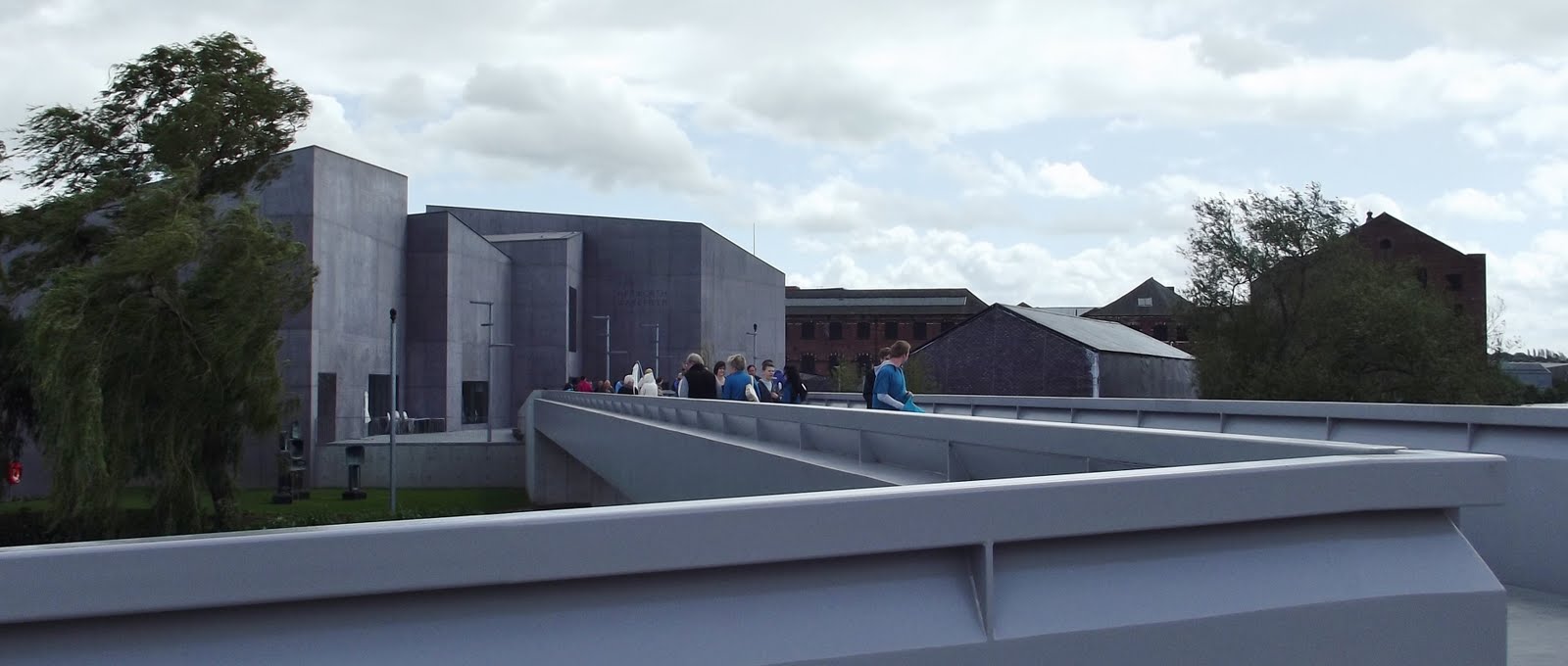
The building in question is, of course, the new Hepworth Gallery. Named for abstract sculptor Barbara Hepworth, who grew up in Wakefield, the architecture is as abstract as she could have wished. We approached from the opposite bank of the River Calder where the strong angularity of the new footbridge framed the gallery’s silhouette, a series of surprising angles against the sky.
Aubergine or Battleship?
The Hepworth, formed with a series of trapezoid blocks in tinted concrete, is all about angles and geometry. There has been some debate about the tint, which has been described as anything from aubergine to battleship. Whatever its name, the chosen colour works. The blocks seem to rise effortlessly from the ever moving waters of the Calder and it is difficult to say if the water takes on the colour of the building or the building adopts the constantly changing hue of the water. The effect of this building forming the river edge at the weir is dramatic and highly photogenic.

With a gallery dedicated to a sculptor, the arrangement of the interior involves more than concerns with wall space. There are both two and three dimensional artworks by a number of artists in the building, but Barbara Hepworth’s sculpture is predominant and enhances the cleverly devised spaces in a way which makes it hard to imagine them without the sculpture. Angled walls and ceilings alter the perspective, creating optical illusions, the true scale of a sculpture is unclear unless compared to the size of a person standing beside it.
Art galleries have to treat delicate artworks with respect. Heat and light can cause irrevocable damage, so many galleries totally exclude daylight from exhibition spaces, an approach which treats the building’s locality as irrelevant. But not at the Hepworth, the trapezoidal galleries are punctuated at strategic locations with windows to bring the riverside into the building, while skylights, cleverly shielded by the angled ceilings inside the galleries, allow natural light to scatter into the space.
Room for Art
The opening of new UK art galleries might seem unexpected given the economic climate, though of course it began when we were all still affluent. The recent completion of several projects shows there is still room to celebrate art in recessionary times. The Hepworth started with an RIBA competition in 2003, which was won by Architect David Chipperfield. Construction commenced in 2007 and the building was handed over in January 2010. Another major art gallery which has opened since January was also designed by David Chipperfield; Turner Contemporary on the seafront at Margate has a profile akin to white yacht sails. I look forward to a trip to the Kent coast.
Back in Wakefield, I thought the interior and contents of the Hepworth were marvellous, but it was a sunny day and I was drawn outdoors to the riverside. Viewed from here, with the Calder weir flowing past, the angles of the Hepworth continue their performance of altering perspective and confusing the eye. This sculptural building is as much a work of art as anything inside.
Wednesday, 6 April 2011
When is a Building a Work of Art?
The Serpentine Pavilions.
When is a building a work of art? It’s safe to say that the average three bed semi, although a perfectly practical abode, is seldom an oil painting, but what about unique, architect designed buildings?
For the past decade, temporary structures which are indisputably works of art have popped up every summer in Kensington Gardens. Commissioned annually by the Serpentine Gallery, internationally renowned architects are falling over each other to be invited to submit a design for the Serpentine’s annual pavilion.
This year’s pavilion will be designed by multi award winning Swiss Architect Peter Zumthor, whose most recent triumph was the 2009 Pritzker Architecture Prize. His 2011 pavilion will enclose a garden by Dutch designer Piet Oudolf – a garden within a pavilion within a garden – it certainly sounds like art.
Jean Nouvel’s red pavilion in 2010 certainly fitted the bill of a work of art, resembling as it did a giant installation by sculptor Sir Antony Caro. The bold forms and vivid colour contrasted well with the surrounding soft shapes and greens of trees and grasses.
When I visited the red pavilion in September it seemed to me to be more successful as a work of art than as a building. Whilst each year’s pavilion is intended to provide space for lectures and other cultural events, the red pavilion appeared to merely function as a café, thus not necessarily meeting the architectural brief.
When is a building a work of art? It’s safe to say that the average three bed semi, although a perfectly practical abode, is seldom an oil painting, but what about unique, architect designed buildings?
For the past decade, temporary structures which are indisputably works of art have popped up every summer in Kensington Gardens. Commissioned annually by the Serpentine Gallery, internationally renowned architects are falling over each other to be invited to submit a design for the Serpentine’s annual pavilion.
This year’s pavilion will be designed by multi award winning Swiss Architect Peter Zumthor, whose most recent triumph was the 2009 Pritzker Architecture Prize. His 2011 pavilion will enclose a garden by Dutch designer Piet Oudolf – a garden within a pavilion within a garden – it certainly sounds like art.
Jean Nouvel’s red pavilion in 2010 certainly fitted the bill of a work of art, resembling as it did a giant installation by sculptor Sir Antony Caro. The bold forms and vivid colour contrasted well with the surrounding soft shapes and greens of trees and grasses.
When I visited the red pavilion in September it seemed to me to be more successful as a work of art than as a building. Whilst each year’s pavilion is intended to provide space for lectures and other cultural events, the red pavilion appeared to merely function as a café, thus not necessarily meeting the architectural brief.
Wednesday, 23 February 2011
Book Review:- "Well Built? A forensic approach to the prevention, diagnosis and cure of building defects," by Robert W. Houghton Evans
Robert Houghton-Evans’ book on building problems comes on top of a long tradition, despite its almost flippant title, Well Built?. Early texts relating to the subject included Lucretius who said, “soft droppes of rain pierce the hard marble” and the New Testament where the faithful were advised to build on rock in preference to sand.
Fast forward to 1976 when Mr. Eldridge gave more modern advice, listing the principles that can be applied to every construction defect situation. Then in 1989 the P.S.A. widened the scope to include specific problems, in a rather unwieldy tome called Defects in Buildings. The B.R.E.’s Building Elements series, intended to replace Eldridge, applies his principles to actual buildings, examining up to date techniques and materials. This technological approach is complimented by publications on professional practice and by case law, so putting it simply, there are three streams of writing on the subject of building defects: Science, Law and Practice. However until now there has been nothing specifically to engage or encourage busy people involved in creating or maintaining buildings, who unexpectedly find themselves involved in a defects dispute and heading towards their solicitor for advice.
Thursday, 20 January 2011
The Latest Thing

While watching an episode of Grand Designs, in which a timber framed house was imported to the home counties from Germany, I was told that this was a new idea. Timber framing is modern, sustainable and is absolutely the latest thing.
Not really though, if you think back to the great fire of London. If those buildings hadn’t been timber framed, the fire would probably never have travelled further than the legendary bakery in Pudding Lane.
Yes, but the timber framed house filmed being erected for Grand Designs was delivered in prefabricated sections and slotted together almost like a flat pack wardrobe. That’s definitely new.
Ok, so it’s probably only a matter of time before IKEA begins to flog whole buildings, but maybe that is the point. These systems have been used in Scandinavia for decades. They have the timber, you know!
However, pre manufactured wooden housing isn’t a even a new idea in the UK. I don’t mean the post war pre-fabs which housed grateful Londoners displaced by the blitz. The history of this building type goes back further than that.
Subscribe to:
Posts (Atom)